The image is from Instagram. Meta has been designated an extremist organization and is banned in Russia.
Mesmerizing…
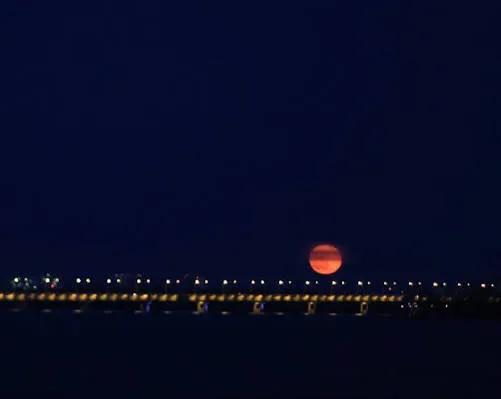
…I thought, looking up at the sky. I was walking home late one evening, along our waterfront.
At that moment I saw a beautiful blood-red Moon slowly rising over the horizon. It was enormous and bright, as if it were about to collide with the Earth. I actually felt a little… scared?
Stopping for a moment, I wondered — why is it red, and why is it so big? Of course, answering these questions would be no trouble at all with a search engine, a book on optics, or any other open source of information. But where would that have left me if this had happened in the, let say, Middle Ages? Or in Babylon?
What Did Ancient People Think?
Let’s turn to Carl Jung’s “Die Archetypen Und Das Kollektive Unbewussten” (free translation of the quote into Russian):
Primitive man doesn’t tend toward objective descriptions of the obvious — instead he feels a pressing need, or rather his unconscious carries an irresistible urge, to liken all outer experience to inner, psychic events. It isn’t enough for him to simply watch the sun rise and set — these outer observations have to become psychic events, meaning the sun’s movement has to represent the fate of a god or hero who, in essence, dwells within the human soul itself. All the mythologized natural processes — summer and winter, the phases of the Moon, the rainy seasons, and so on — aren’t so much allegories of objective phenomena as symbolic expressions of an inner, unconscious drama, made accessible to human consciousness through projection, that is, reflected in the phenomena of nature. This projection is so fundamental in character that it took several thousand years to separate it from its outer object even a little.1
So a blood-red Moon — which became that color because of how light bends in Earth’s atmosphere — could have been perceived by ancient people as an omen of something terrible, the arrival of divine wrath. They certainly had a drive to understand and explain the phenomena of nature, but it was limited by their knowledge and experience. So they reached for the mythological explanations available to them.
What’s more — the existence of some kind of absolute truth makes building a picture of the world many times simpler. The divine images born of myth explained quite well why the Moon was red and huge, why it rose and set.
Jung calls phenomena like this archetypes — something divine, inexplicable. Something with roots in something ancient, primordial. Free translation of the quote into Russian:
His knowledge of nature is, in essence, the language and outer manifestation of an unconscious psychic process. And it’s precisely because of this unconsciousness that, in interpreting myths, people turned to anything and everything except the psychic. He simply didn’t know that the psyche contains within it all the images that gave rise to myths, and that our unconscious is at once an acting and an acted-upon subject, whose inner drama primitive man discovered, by analogy, in natural phenomena both great and small.2
Inconscientia collectiva
We’re used to explaining the world through facts, but facts don’t always satisfy the need for meaning. Archaic humans, lacking the apparatus of natural science, explain the world through the lens of representations, since an explanation through the lens of facts isn’t to be found.
The collective unconscious, in these terms, is an innate layer of the psyche shared by all of humanity. Its contents are archetypes — universal images and scenarios that show up in myths, dreams, and symbols.
It might seem like “savages” weren’t smart enough to understand the world, but for ancient people, myth was a way of living out an inner drama. Primitive man was deep — just in his own way.
Today we know why the Moon turns red. But knowing that doesn’t cancel out the ancient feeling: looking at it, we can still sense something more than just the refraction of light. Archetypes haven’t gone anywhere — they sit firmly in the collective unconscious. The only difference is that we no longer project them onto the sky literally, but we still feel them from within.
And maybe Schiller was right when he wrote: “In your breast, and there alone, lie all the stars of your fate.”3